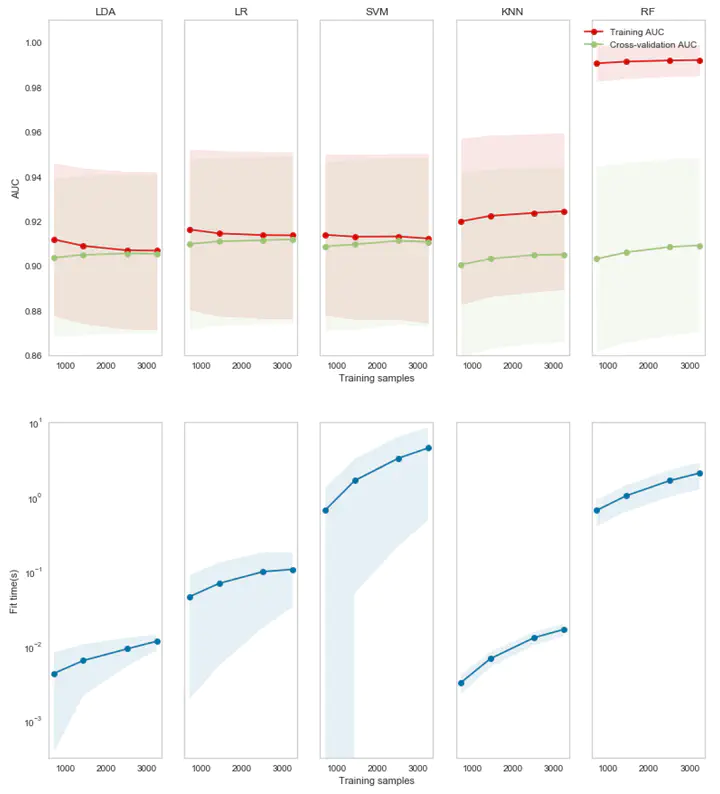
 AUC (first row) and time for training (second row) for each of the five investigated algorithms (in each column) with different numbers of observations. The lines represent the population averages and the shadows the standard deviation.
Abstract
The need for automatic detection and classification of high-frequency oscillations (HFOs) as biomarkers of the epileptogenic tissue is strongly felt in the clinical field. In this context, the employment of artificial intelligence methods could be the missing piece to achieve this goal. This work proposed a double-step procedure based on machine learning algorithms and tested it on an intracranial electroencephalogram (iEEG) dataset available online. The first step aimed to define the optimal length for signal segmentation, allowing for an optimal discrimination of segments with HFO relative to those without. In this case, binary classifiers have been tested on a set of energy features. The second step aimed to classify these segments into ripples, fast ripples and fast ripples occurring during ripples. Results suggest that LDA applied to 10 ms segmentation could provide the highest sensitivity (0.874) and 0.776 specificity for the discrimination of HFOs from no-HFO segments. Regarding the three-class classification, non-linear methods provided the highest values (around 90%) in terms of specificity and sensitivity, significantly different to the other three employed algorithms. Therefore, this machine-learning-based procedure could help clinicians to automatically reduce the quantity of irrelevant data.

Manousos Klados
Associate Professor of Psychology
Manousos Klados is a mathematician, with a M.Sc. in Computational Neuroscience and a PhD in the borders of Affective, Cognitive and Computation Neurosciences. Currently he is an Assoc. Professor in Psychology at University of York Europe Campus - CITY College.