Which BSS method separates better the EEG Signals? A comparison of five different algorithms
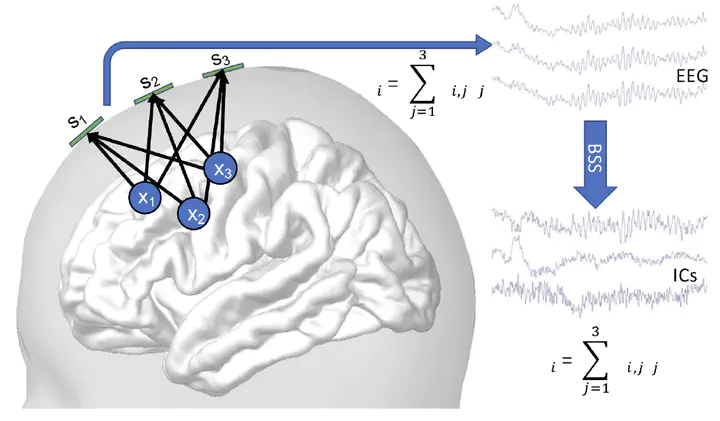 The scalp electrodes (S1, S2, S3) receive the linear mix of the electrical activity generated from different neuronal sub-areas inside the brain (X1, X2, X3) in different volumes. Then the signal is amplified and illustrated on a computer screen. By using a BSS method, the raw EEG signal from the different electrodes is decomposed to the same number of Independent Components.
Abstract
A very common strategy for rejecting electroencephalographic (EEG) artifacts, includes the decomposition of filtered EEG signals using a Blind Source Separation (BSS) algorithm, the identification and removal of artifactual components and the reconstruction of the cleaned EEG signals. In this pipeline, the performance of the BSS algorithm, which is defined as its ability to separate properly the independent sources (like the EEG from artifactual sources), is very crucial for rejecting most of the artifacts, while maintaining the most part of EEG intact. The overwhelming majority of the published papers uses the extended INFOMAX version of Independent Component Analysis (ICA) for artifact rejection purposes. But is this the most efficient algorithm to separate EEG signals into independent components? This study comes to shed light to the aforementioned question by assessing the performance of the five most common BSS algorithms. The normalized entropy of the brain-related components, their correlation between independent components with the original sources and the amount of the overall mutual information reduction (MIR) achieved by each decomposition were computed in datasets with systematically varying numbers of electrodes (ranging from 19 tο 99), from 26 real human scalp EEG recordings. Additionally, 54 different datasets containing artificially contaminated EEG signals were also examined for the same purpose, on the basis of the Euclidean distance and the correlation, between the generated Independent Components (ICs) and the original vertical and horizontal eye signals, which were used for the contamination. The results support that the Adaptive Mixture ICA was the best performing BSS method.
Supplementary notes can be added here, including code, math, and images.

Manousos Klados
Associate Professor of Psychology
Manousos Klados is a mathematician, with a M.Sc. in Computational Neuroscience and a PhD in the borders of Affective, Cognitive and Computation Neurosciences. Currently he is an Assoc. Professor in Psychology at University of York Europe Campus - CITY College.